2026 breed risk report: The breeds and desert hazards behind Las Vegas pet emergencies
If outside the area, please call your nearest emergency vet.

Life in Southern Nevada comes with unique challenges for pets, from scorching summer temperatures to breed-specific health concerns that can turn routine problems into emergencies. Veterinary Emergency + Critical Care surveyed 204 Nevada dog and cat owners to examine what sends pets to the ER, how often those cases require a specialist, and whether owners are financially and medically prepared when emergencies happen.
Throughout this report, figures describe all 204 Nevada respondents unless a Las Vegas comparison is stated. Where Las Vegas area residents are called out separately, that subset is 105 respondents.
Key takeaways
- Two of Las Vegas's three most popular dog breeds are flat-faced, in a city that saw 77 days at or above 100 degrees in 2025.
- Nearly half of pet ER visits (47%) escalate into needing a specialist, and cat emergencies escalate more often than dog emergencies (54% vs. 38%).
- Stomach emergencies drove 60% of dogs' ER trips, and toxic ingestion drove 27%.
- Extreme heat (58%) and hot pavement (47%) top the list of hazards named by respondents.
- 52% of Nevada pet owners couldn't cover a $1,000 pet emergency without going into debt.
- Mixed-breed pet owners are among the least prepared, with 58% unable to cover a $1,000 emergency.
- 59% of owners have neither pet insurance nor emergency savings.
Baby boomers hold the biggest breed-risk blind spot
Breed knowledge in Nevada is split less by species than by generation.
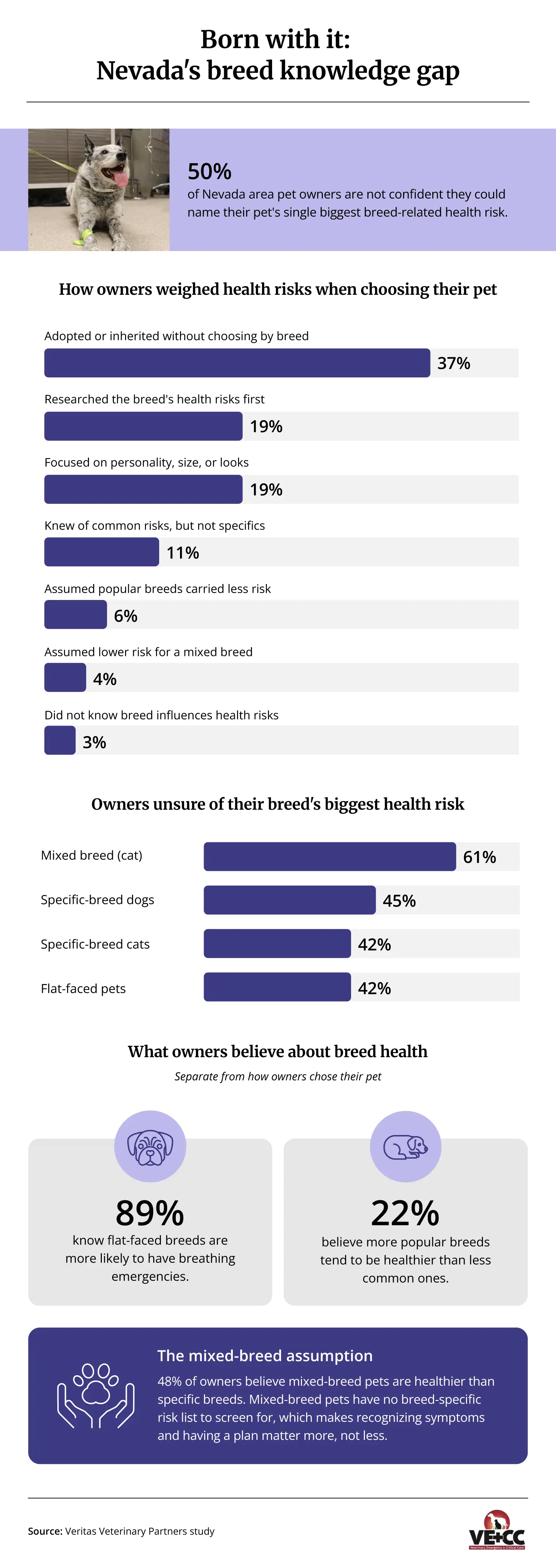
Half of Nevada owners (50%) couldn't confidently name their pet's biggest breed-related health risk; 21% were very confident, 30% somewhat, 36% not very, and 14% not at all. The gap widened dramatically with age. About 3 in 4 baby boomers (74%) couldn't confidently name their pet's biggest risk, while just 38% of millennials said the same.
That includes owners of mixed-breed pets, who were less confident than owners of a specific breed (58% versus 44%). Mixed-breed cat owners were the least sure of their pet's health risks (61%), which is unsurprising given that mixed-breed pets have no single breed profile to draw on. Owners of flat-faced pets were the most confident group, with 58% saying they could name their pet's biggest risk. Mixed-breed cats here include Domestic Shorthairs and Domestic Longhairs, the standard terms for cats without a specific documented breed, alongside owners who described their cat as a mix. First-time owners bucked the usual pattern, coming in at 31% not confident, compared with 54% among experienced owners.
How pets arrived mattered: 37% were adopted or inherited without choosing by breed, and just 19% of owners researched risks first. Familiar beliefs surfaced as well. Most owners (89%) knew flat-faced breeds face a higher breathing risk and 48% believed mixed breeds are healthier. We also asked whether a breed's built-in health risks are mostly out of an owner's control, and 46% said they are. In practice they aren't. Weight management, breed-specific screening, and knowing which symptoms warrant an ER visit all change how a predisposition plays out. Baby boomers were the most likely to believe mixed breeds are healthier, at 74%, compared with 32% of Gen Z.
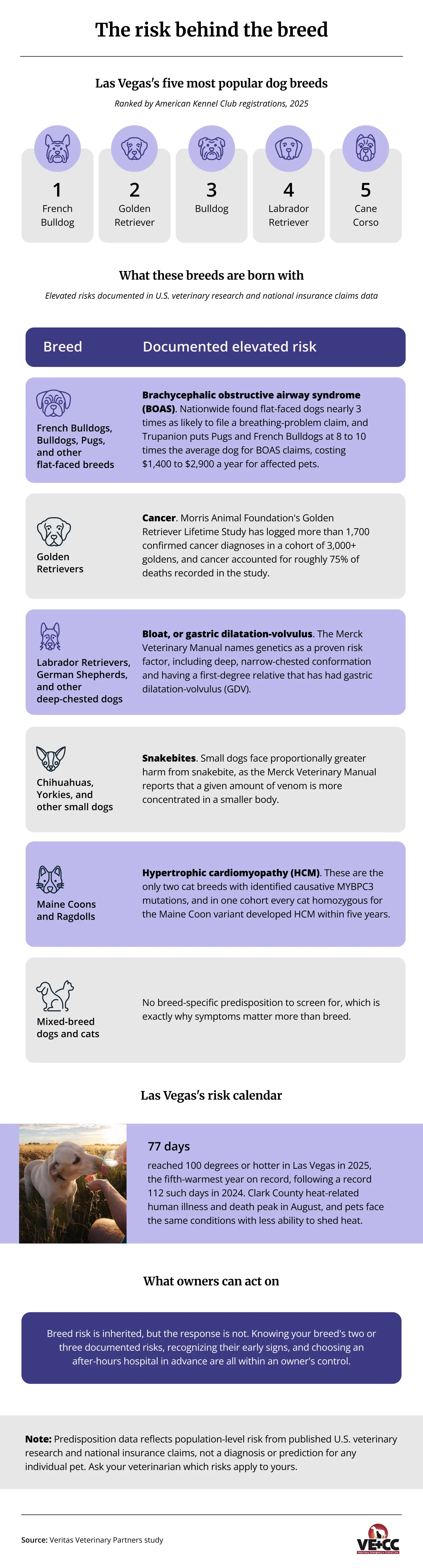
The American Kennel Club's (AKC) 2025 registrations rank the French Bulldog, Golden Retriever, Bulldog, Labrador Retriever, and Cane Corso as Las Vegas's five most popular dog breeds. Two of the top three are flat-faced, which matters more here than almost anywhere. Flat-faced dogs shed heat less efficiently through panting, and the National Weather Service recorded 77 days at or above 100 degrees in Las Vegas in 2025, the fifth-warmest year on record, following a record 112 such days in 2024.
Clark County's heat burden is severe enough that the Southern Nevada Health District reports human heat-related illness and death peaking in August, and pets face the same conditions with less ability to shed heat. Nationwide's analysis of more than 50,000 brachycephalic dogs found them nearly three times as likely to file a breathing-problem claim, and Trupanion puts Pugs and French Bulldogs at eight to 10 times the average for brachycephalic obstructive airway syndrome (BOAS) claims, with costs of $1,400 to $2,900 a year for affected pets.
Other local favorites carry their own documented risks. The Merck Veterinary Manual lists the Labrador Retriever's deep-chested build among those most associated with bloat, alongside Great Danes and German Shepherds, with mortality of 20% to 45% even in treated dogs, and the Golden Retriever Lifetime Study has logged more than 1,700 confirmed cancer diagnoses among its 3,000-plus goldens studied.
Stomach emergencies dominate dogs' ER trips
Half the market had already lived through a pet emergency, and one cause towered over the rest for dogs.
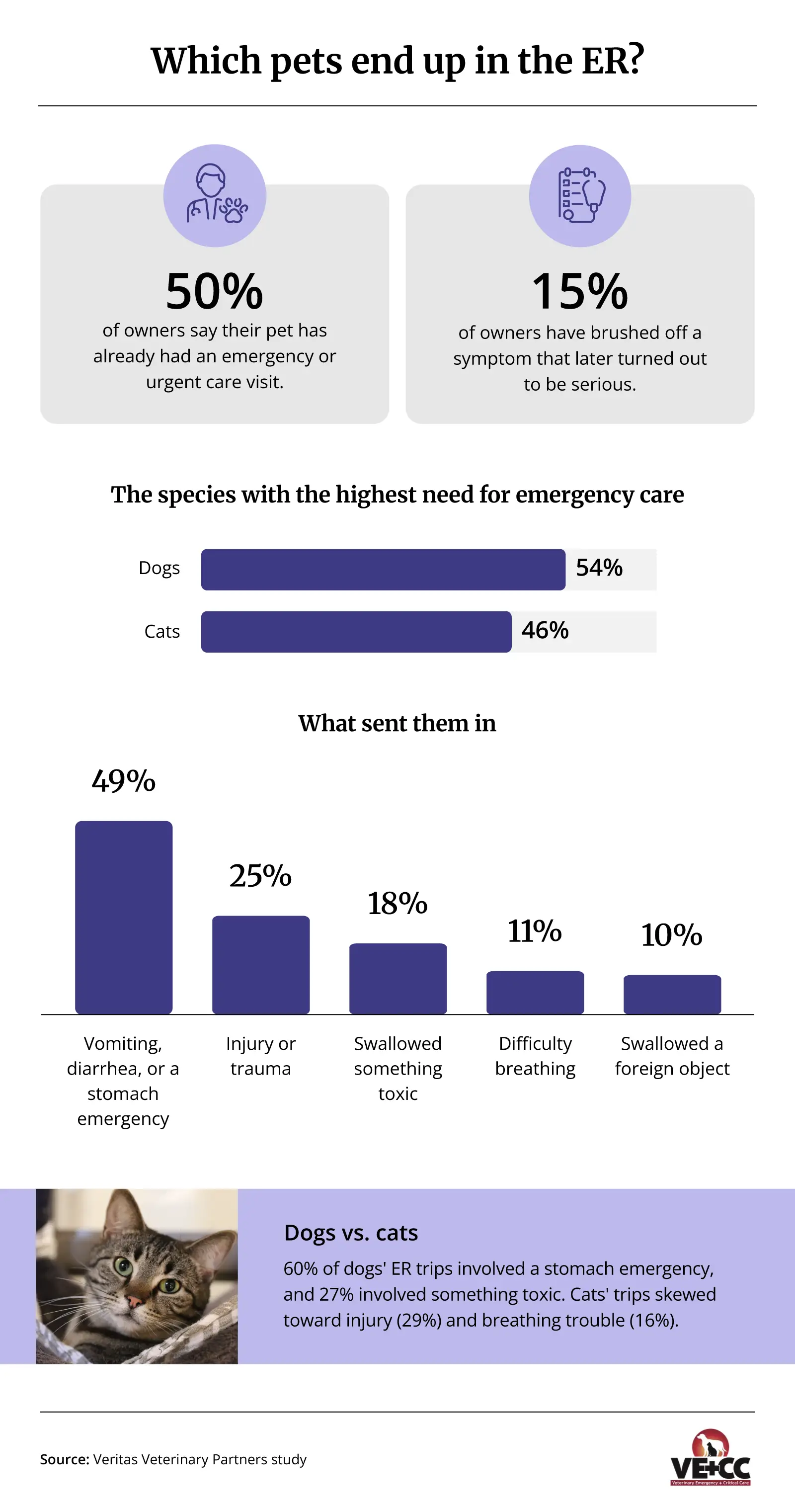
Half of Nevada pet owners (50%) said their pet has already made an emergency or urgent care visit. Stomach emergencies caused 49% of those trips, with injury or trauma at 25%, toxic ingestion at 18%, breathing trouble at 11%, and foreign objects at 10%. Las Vegas residents reported a higher rate of urgent visits than the rest of the state (54% vs. 44%).
Stomach emergencies drove 60% of dogs' ER trips, and toxic ingestion drove 27%, while cats skewed toward injury (29%) and breathing trouble (16%). Dogs had a higher emergency history rate than cats (54% vs. 46%).
About 15% of owners reported brushing off a symptom that later turned serious, and first-time owners did so at nearly twice the rate of long-time owners (23% vs. 13%).
Heat and hot pavement rule the worry list
Desert hazards dominated the local imagination, and for good reason.
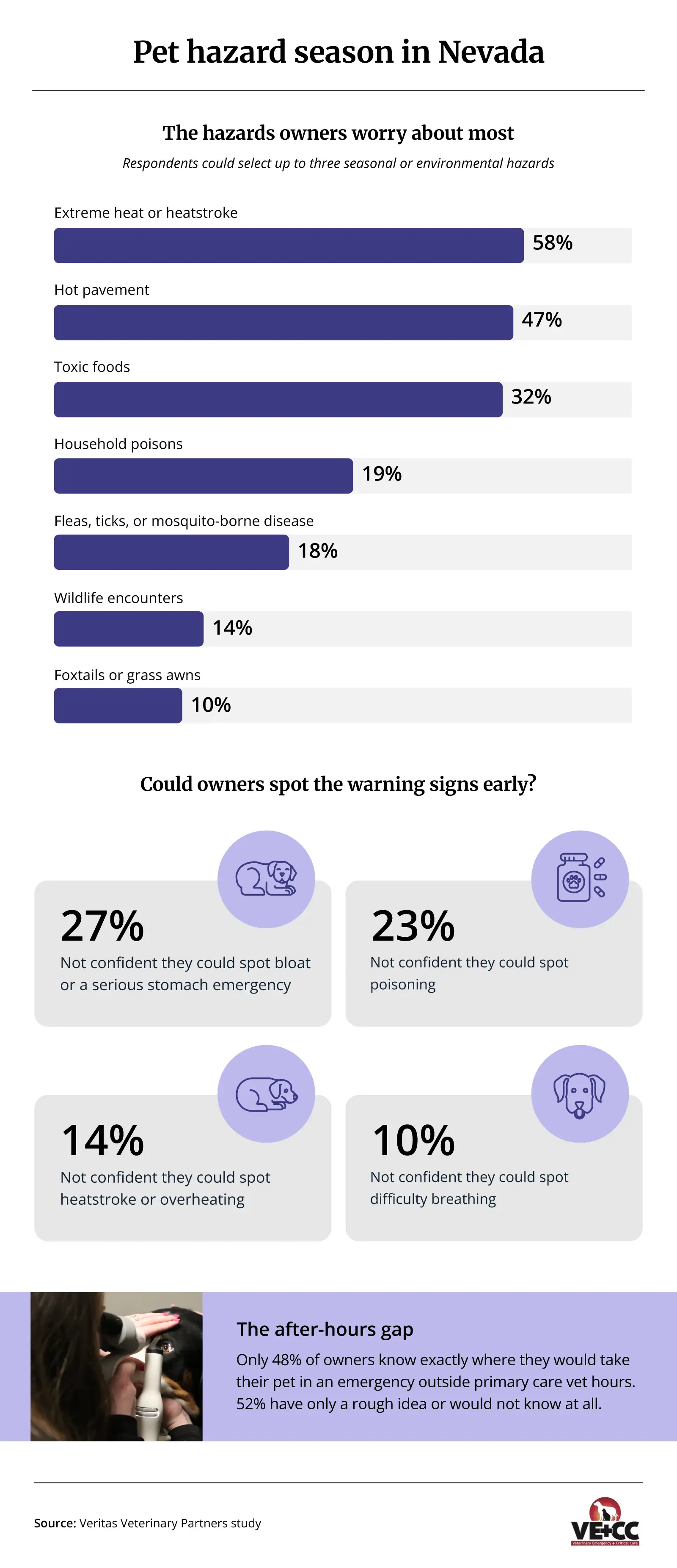
Extreme heat worried 58% of Nevada owners, and hot pavement 47%, with toxic foods a distant third at 32%. Within the Las Vegas metro area, the numbers climbed further, to 65% for heat and 50% for pavement. Heat was also the hazard owners felt least prepared to handle, at 17%. Regarding toxic foods, ASPCA Poison Control logged more than 376,000 reported exposures nationally in 2025, with food and drink ranking second.
Recognition gaps followed, with 27% of owners not confident they could spot bloat early, 23% saying the same for poisoning, and 14% for heatstroke. Just under half (48%) knew exactly where they'd go in an after-hours emergency, 45% had a rough idea, and 7% wouldn't know.
More than one in 10 pet owners (14%) had concerns about wildlife encounters. For small-dog owners, preparation for snakebite incidents is especially important, as the venom is more potent in smaller animals.
Nearly half of ER visits become specialty cases
In this market, the ER was often the first department of several.
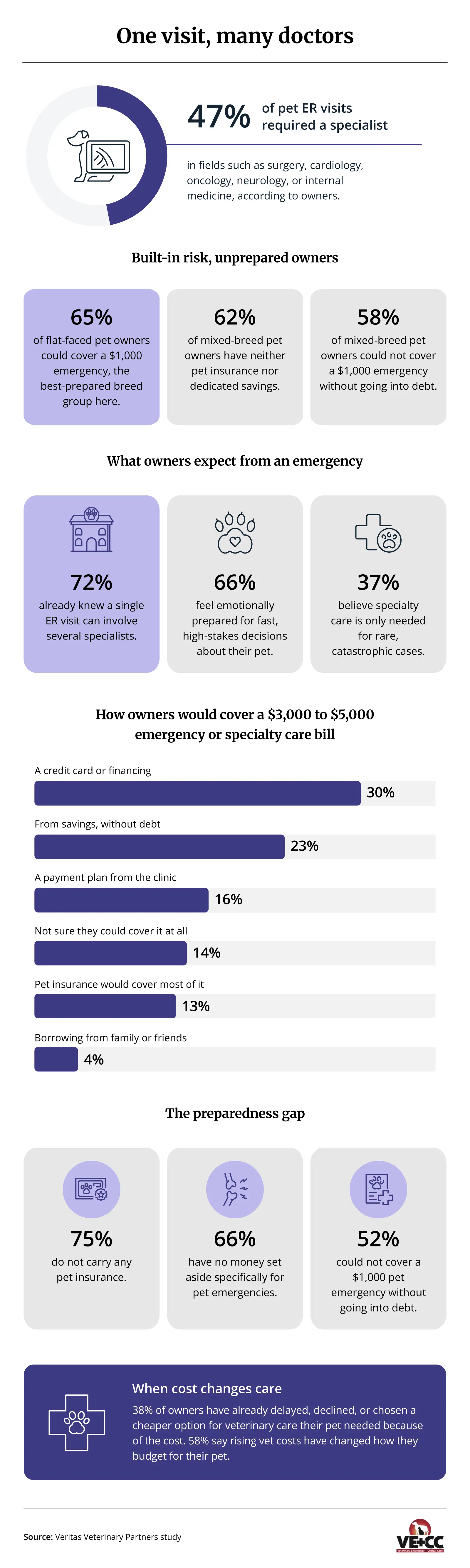
Among owners whose pet reached the ER, 47% said the visit required a specialist, in fields such as surgery, cardiology, oncology, neurology, or internal medicine, and cat emergencies did so far more often than dog emergencies (54% vs. 38%). Mixed-breed cats' visits led the way, escalating at 56%. Most owners (72%) knew that a single visit can involve several specialists, though 37% believed specialty care is only for rare catastrophes. Two-thirds (66%) felt emotionally prepared, and 58% said rising costs had changed their pet budget.
Advanced cases require advanced care, and that carries higher costs. A hospital staffed around the clock with board-certified specialists is a different operation from a primary care practice, with different equipment, staffing, and overnight capability. Take one of the most common stomach emergencies. Surgery to clear an intestinal blockage in a dog averages $4,261 in Nevada, close to the $4,383 national average, according to CareCredit, drawing on a 2025 Synchrony procedural cost study. For cats, foreign body removal averages $2,296 in the state. Those are cost-research figures, not pricing at any Veritas hospital.
That's why we asked owners how they would pay a bill of that size. For a $3,000 to $5,000 bill, 30% would use a credit card, 23% would use savings, and 16% would use a payment plan, while 14% weren't sure they could cover it. Cost changes had already led 38% of owners to delay, decline, or downgrade treatment.
Mixed-breed pet owners were among the least prepared, with 58% unable to cover a $1,000 emergency and 62% lacking both insurance and savings. Owners of flat-faced pets were the best prepared of the breed groups, with 65% able to cover it. Income split the market sharply (73% of owners earning $25,000 to $49,000 couldn't cover $1,000, against 19% earning $100,000 or more), and 84% of baby boomers had neither insurance nor savings.
ASPCA reported this year that roughly six in 10 U.S. pet owners lack confidence that they could afford a pet medical emergency. In this market, 52% could not cover even $1,000 without going into debt. Two-thirds (66%) had no money set aside for pet emergencies, and 75% had no pet insurance for this pet. Some owners had one but not the other, which leaves 59% with neither a cushion nor a policy.
Better odds start with a plan
Las Vegas pets live with hazards most of the country only reads about, and the data shows the risk doesn't stop at the ER doors. Owners can shift the odds by learning their breed's specific vulnerabilities, treating heat and pavement as seriously as the numbers suggest, and choosing an after-hours destination before they need one, knowing that emergency and specialty teams work side by side on the same campus. A savings cushion or an insurance policy can also stack the deck a little further in your pet's favor.
Methodology
To explore how well pet owners understand their pets' breed-related health risks and how prepared they are for veterinary emergencies in a desert climate, we surveyed 204 Nevada dog and cat owners via online survey panels from June 22 to July 14, 2026. Of these, 105 respondents (51%) lived in the Las Vegas area, and the remainder lived elsewhere in the state. These regions reflect the markets served by Veterinary Emergency + Critical Care.
Respondents who owned more than one pet were asked to answer about the single pet they would be most worried about in a medical emergency. Among respondents, 41% answered about a dog and 59% about a cat; 56% were women, and 44% were men. All respondents were adults ages 18 and older. By generation, 18% were Gen Z (ages 18 to 29), 35% were millennials (ages 30 to 45), 37% were Gen X (ages 46 to 61), and 9% were baby boomers (ages 62 and older).
Questions about the causes of emergency visits and the escalation to specialty care were asked only of the 101 respondents whose pet had experienced an emergency or urgent-care visit. Percentages for multi-select questions are based on all respondents shown the question and may total more than 100. All figures are rounded to the nearest whole percentage, so some totals may not equal 100.
This report also draws on published U.S. data. Breed commonality reflects the American Kennel Club 2025 registration statistics for Las Vegas. Breed predisposition figures come from Nationwide's analysis of more than 50,000 brachycephalic dogs; Trupanion claims data; Morris Animal Foundation's Golden Retriever Lifetime Study, an ongoing cohort of more than 3,000 dogs; the Merck Veterinary Manual; the American College of Veterinary Surgeons; the Dog Aging Project's analysis of 47,444 dogs; and published research on feline hypertrophic cardiomyopathy genetics.
Seasonal and toxin figures come from ASPCA Poison Control's 2025 exposure data. Snakebite information is from the Merck Veterinary Manual. Emergency surgery costs come from CareCredit's published Nevada averages, based on a 2025 Synchrony Average Procedural Cost Study conducted by ASQ360° Market Research, and are not pricing at Veritas hospitals.
Breed categories reflect what owners reported. "Specific-breed" means the owner identified a single breed rather than a mix; it does not imply registry documentation.
Affordability comparisons are based on a 2026 ASPCA survey and the PetSmart Charities-Gallup State of Pet Care study. Predisposition data describes population-level risk, not a diagnosis or prediction for any individual pet. Human heat figures come from the National Weather Service Las Vegas office and the Southern Nevada Health District.
About Veterinary Emergency + Critical Care
Veterinary Emergency + Critical Care serves Las Vegas pets when the stakes are highest, providing 24/7 emergency and critical care with emergency-trained veterinarians, on-site diagnostics, and fully equipped surgery suites. Board-certified specialists are available on call to consult on complex cases. VE+CC's sister hospital, Las Vegas Veterinary Specialty Center, offers specialty care in internal medicine, surgery, cardiology, neurology, oncology, ophthalmology, and anesthesiology. When a routine problem turns serious, the two hospitals can take a case as far as it needs to go.
Fair use statement
This content is free to share for noncommercial purposes. We just ask that you credit Veterinary Emergency + Critical Care and link back to this page when doing so.
The information contained in the article is for informational purposes only and is not intended to take the place of the advice of a veterinarian.